 Formed of Light
Body Projection vs. Living Canvas
Published July 1, 2026 · Timothy Osier
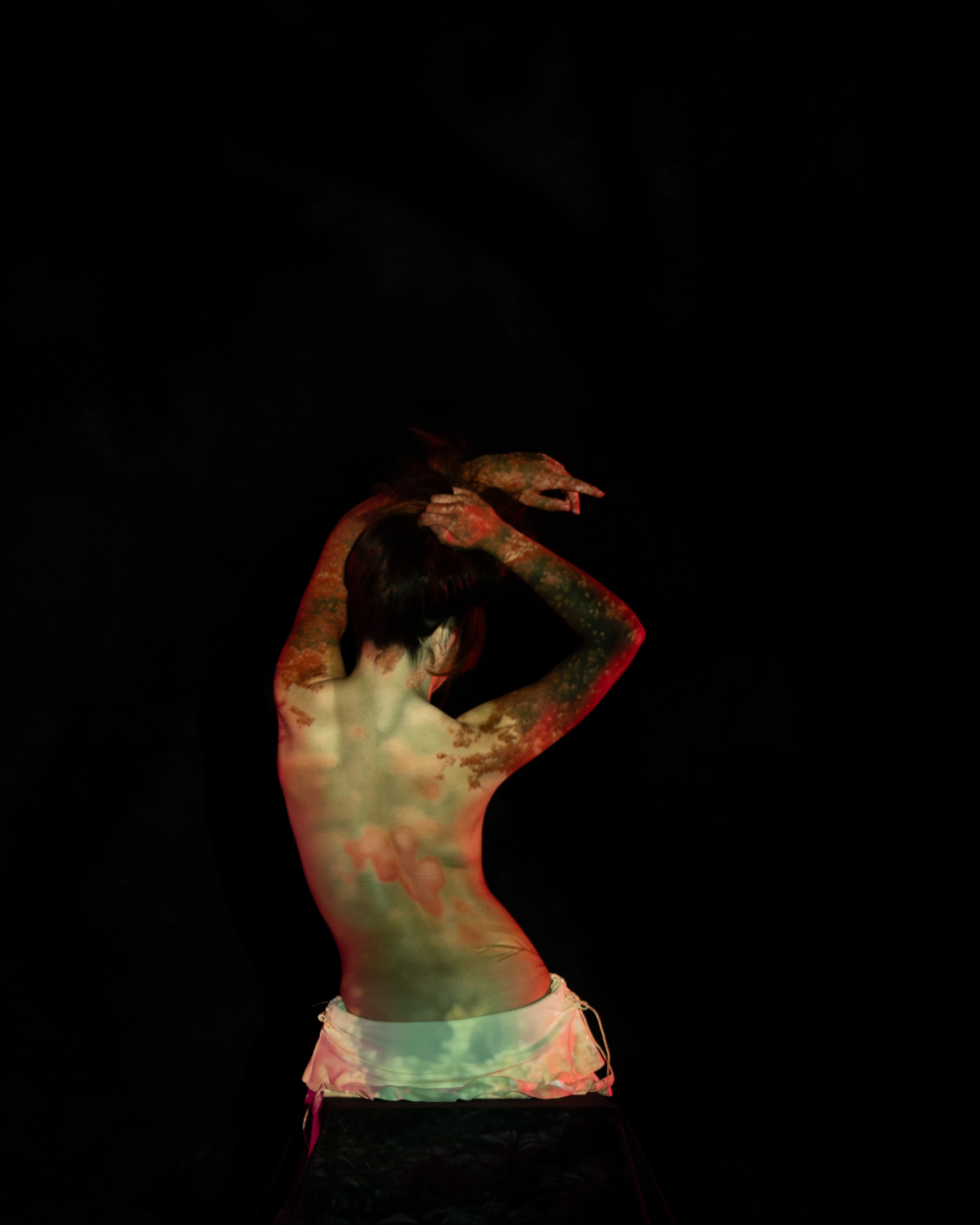
If you're exploring creative portrait photography, you've probably noticed that not all projection work shares the same artistic goal. At Formed of Light Studio we offer two distinct projection experiences — Body Projection and Living Canvas. Both use projected light, but they create entirely different kinds of artwork.
One explores how light interacts with the human form. The other transforms the body into a canvas for artwork that already exists — or artwork created specifically for you. Neither is better; they simply tell different visual stories.
Body Projection: light becomes part of you
Body Projection is about the relationship between light and the human form. Rather than projecting recognizable photographs or paintings, we typically work with abstract patterns, flowing textures, gradients, and color. As the projected light wraps across the body, every pose changes the artwork itself — the body doesn't simply display the projection, it shapes it. Every curve, movement, and shift in posture creates something unique that can't be repeated.
The resulting images feel sculptural, surreal, organic, and dreamlike. Instead of hiding the body beneath artwork, the light celebrates it — emphasizing form, movement, and expression.
Typical wardrobe for body projection
Because the goal is for light to flow naturally across the body, clothing is usually kept minimal. Many sessions are photographed topless or nude, but full nudity is never required. Common choices include:
- Skin-tone seamless underwear
- Adhesive bras
- Pasties
- Other minimal garments that let projected light wrap naturally around the body
Your comfort always comes first, and wardrobe is discussed before the session so you can decide what feels right for you.
Living Canvas: wear the art
Living Canvas has a very different artistic goal. Instead of emphasizing the body's shape through abstract light, it turns your body into a canvas for artwork. Paintings, photographs, illustrations, digital art, textures, handwritten pieces, or other meaningful imagery are projected directly onto your back, creating the illusion that the artwork lives on your body itself.
Every person becomes a one-of-a-kind gallery. Because every back has different contours and proportions, the same artwork never appears exactly the same on two people.
Bring your own artwork
One of the most personal aspects of a Living Canvas session is that — while we keep a rich library to choose from — the artwork doesn't have to come from us. Many clients bring pieces that already hold personal meaning. You might project:
- Your own photography
- Original paintings
- Digital artwork
- Family artwork
- Meaningful illustrations
- Anything else that tells your story
As long as it can be digitized, it can usually become part of your session. Just scan or photograph the artwork at high resolution and send us the files beforehand — we'll review everything during concept planning to make sure it projects beautifully.
How Living Canvas is created
Living Canvas uses a specialized three-projector setup. One projector displays the artwork across your back, while two more create carefully controlled rim lighting that separates your body from the black background. This preserves the richness of the projected artwork while giving your silhouette depth and definition. The result is elegant, painterly, and unlike traditional portrait photography — your body becomes the canvas, and the artwork remains the star.
Wardrobe for Living Canvas
Here, a clean canvas is the priority — the more uninterrupted your back, the more convincing the final artwork. Ideal options include:
- Shirtless/topless
- Backless dresses
- Adhesive bras
- Pasties
If you prefer more coverage, a light-colored, form-fitting shirt still projects well, though seams and fabric texture may show depending on the artwork. Traditional bras, bikini straps, and other garments that cross the back naturally divide the projected image and reduce the illusion of a continuous canvas.
The biggest difference
Although both use projected light, they chase different goals.
Body Projection asks: "How can light transform the human body?" The emphasis is on movement, curves, color, and the way light flows across the form.
Living Canvas asks: "What if the body became the canvas itself?" The emphasis is on the artwork being displayed — and the deeply personal connection created when that artwork becomes part of you.
Which experience is right for you?
Choose Body Projection if you're drawn to:
- Abstract patterns and flowing light
- Color and sculptural imagery
- Surreal fine-art portraits
- Images where light becomes part of your body
Choose Living Canvas if you're drawn to:
- Fine art, paintings, and photography
- Personal storytelling
- Displaying meaningful artwork
- Images that couldn't exist on anyone else
Some clients arrive knowing exactly which direction they want. Others bring an idea, a favorite piece of artwork, or simply a feeling they hope to capture. Together we'll decide which approach — or combination of both — best brings that vision to life.
Can they be combined?
Absolutely. Many sessions begin with Living Canvas portraits before transitioning into Body Projection images that emphasize movement, color, and abstract light. Because every session is individually designed, the techniques always serve the concept — never the other way around.
Your story, your artwork
Whether you're celebrating an artist you admire, preserving a piece of family history, showcasing your own work, or simply exploring the relationship between light and the human form, projection photography opens possibilities that don't exist in traditional portraiture.
Browse both styles side by side — the body projection gallery and the Living Canvas gallery — and find current pricing on the booking page. New to projection entirely? Start with What Is Body Projection Photography?

Founder and photographer at Formed of Light Studio — art-forward portrait, projection, and fine-art body work in Newnan, GA, serving Atlanta and beyond.